
Center for Open Data in the Humanities
Big Data of Japanese Culture and AI for the Humanities
AI-driven research for the humanities (“AI for Humanities”) has the potential to fundamentally transform the methodology of humanities research going forward. The Center for Open Data in the Humanities (CODH) has, to date, built and published a wide variety of humanities big data, while advancing joint research with many humanities scholars and co-creating use cases for data-driven research. Going forward, while actively incorporating the latest AI methods, we will pursue deeper big-data analysis centered on Japanese culture and advance knowledge sharing and community formation, so these methods and their outcomes reach a wider range of people.
Toward a Japanese Culture AI Built on Big Data and a Knowledge Infrastructure
Japan has carefully preserved its cultural heritage, but for people today to use it, various gaps must be overcome. For example, reading a book from before the Edo period requires not only the ability to read historical characters (kuzushiji) and classical text (kobun), but also knowledge of the past world, such as place names and personal names. To bridge these gaps, we are building a computational infrastructure that integrates diverse types of AI—including purpose-specific AI and agentic AI—together with a knowledge infrastructure that provides access to concepts from the past world, to advance AI-driven research based on big data of Japanese culture. Building this kind of Japanese-culture AI is also an important mission for expressing Japanese culture in new forms and communicating it to the world.
The DH Consortium (DiHuCo) and the Formation of an AI-Driven Research Community
The DH Consortium (DiHuCo), established under MEXT’s “Research and Development Promotion Project for DX in the Humanities and Social Sciences,” is working on three tasks. First, we collect “use cases” in digital humanities centered on geographic information and AI and create guidelines that consolidate best practices. Second, we work with domain specialists to build a diverse, high-quality, large-scale geographic dataset covering the Edo period to the present, and to publish it as open data. Third, we build applications and services based on co-creation with humanities scholars, and — through means such as seminars and shared guidelines — deepen the frontier of AI-driven humanities research, expand its base, and promote the formation of a community for AI-driven humanities research in Japan.
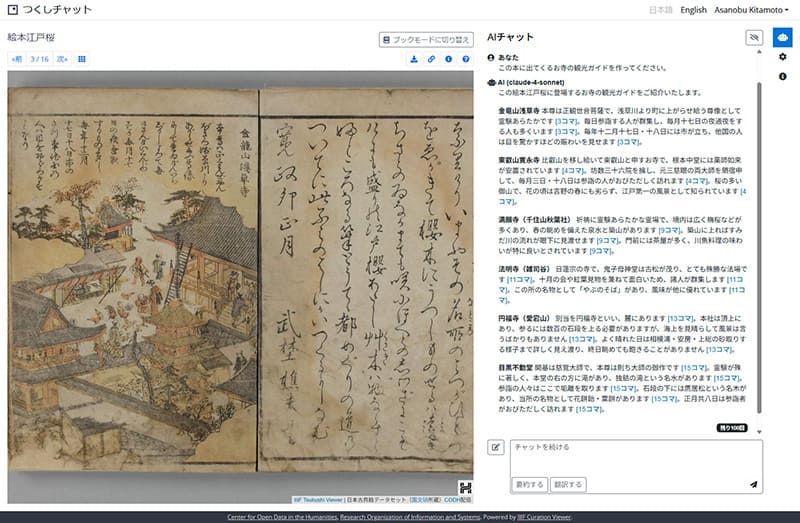 An Example of Asking Tsukushi Chat About “Ehon Edo Zakura”
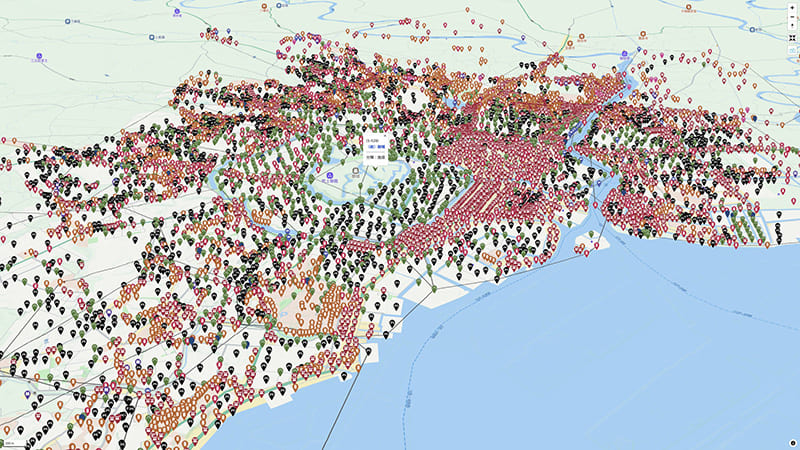 Edo Maps Place-Name List — “Rekichizu” Bird’s-Eye View
Members
- Asanobu Kitamoto — Director
- Tadahiko Maeda
- Tomoko Yamamoto
National Institute of Informatics:
- Keizo Oyama — Collaborator
- Akiko Aizawa — Collaborator
The Institute of Statistical Mathematics:
- Daichi Mochihashi — Collaborator